
Foundations for Higher Education in Prison Teaching
Faculty teaching inside prisons need robust, culturally-responsive, and trauma-informed training materials. In this project, ITHAKA Labs worked with the University of Puget Sound to evaluate a learning management system and course delivery design for faculty who are interested in, or already teaching in, higher education in prison (HEP) programs.
Background
We teamed up with the University of Puget Sound on a discovery project to explore and pilot methods to support teaching in prison and enable instructors to share their experiences with others. Based on the Bridging the Divide report and interviews with HEP alumni, faculty, and administrators across the country, it was clear that faculty need ongoing support for teaching inside prison. To meet their needs, ITHAKA Labs helped set up a learning management system solution that could be used by faculty, regardless of institutional affiliation, to participate in module-based training.
What we did
Over five months, our teams convened for regular biweekly meetings that helped shape the course of discovery from setup through to the pilot and evaluation:
- ITHAKA Labs configured a course in Moodle, an open source learning management system (LMS), to host and deliver the course materials. This involved exploring open source packages that would best support course delivery.
- Concurrently, the team at the University of Puget Sound developed course materials with contributions from over two dozen experts in the field, professional creators and editors, and instructional designers who translated the materials into an interactive course format.
- We selected a pilot cohort of 12 faculty members with a range of lived experiences and familiarity teaching inside from the following community colleges, universities, and community organizations:
- Cascadia College
- Madison College
- Operation Restoration
- Southeast Community College
- The Petey Greene Program
- Truckee Meadows Community College
- University of Puget Sound
- Western Nevada College
- Yale University
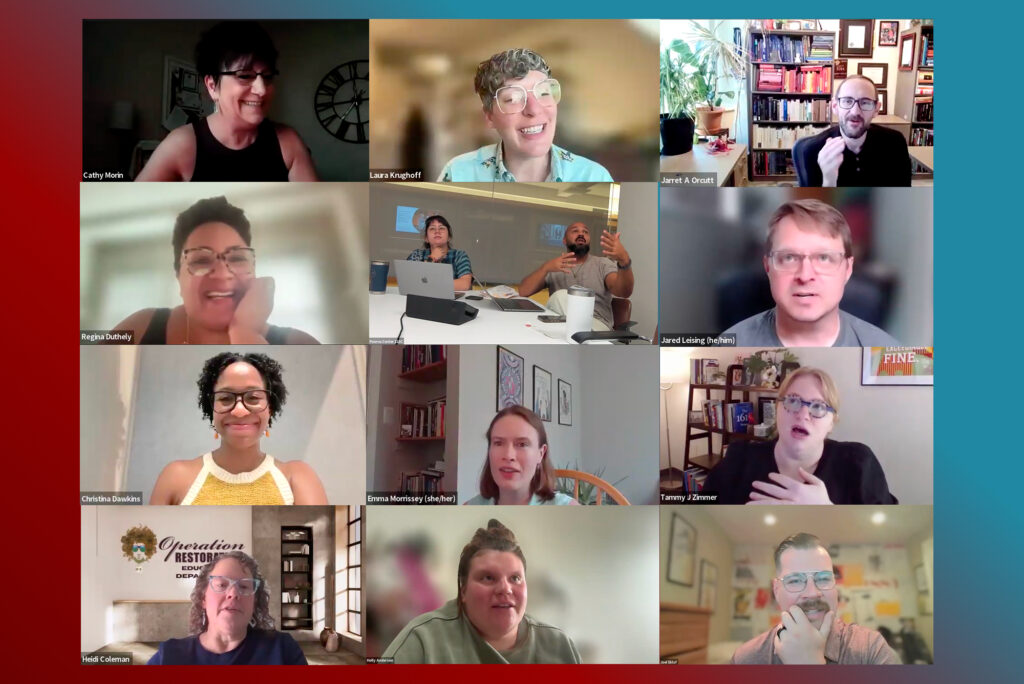
- We held a one-week virtual pilot course for the participants, with facilitation support from Christina Dawkins, an academic and activist who works with higher education in prison consortia, that met once a day for a synchronous discussion. We sat in on discussions about course design, pacing, teaching scenarios, course delivery, and approaches to teaching adult learners. After completing the course, participants received a pilot microcredential from JSTOR Access in Prison.
- We gathered participants’ initial reactions through a post-course survey. The survey asked about their satisfaction with the course, confidence in applying what they learned, experience using Moodle, and suggestions for improving the content.
- ITHAKA Labs facilitated a one-hour final workshop where we walked through the overarching faculty experience, from how prospective participants might discover the materials to the support they would need to use them in practice.
- We updated the curriculum based on our learnings and made two versions of the finalized course available: open source as a downloadable PDF and accessible via Moodle (with availability to export the entire course into another LMS).
What we built
The Foundations for Higher Education in Prison Teaching is a modular course available on Moodle with possible future open-license access. The course includes a series of videos, discussion posts, key terms, practice scenarios based on real experience, and practical tools for adapting current curriculum to the higher education in prison context.
The pilot modules cover:
- Understanding Prison Context and Why HEP Matters
- Using Humanizing, Trauma-Informed Teaching Practices
- Working with Non-Traditional Adult Learners in a Prison Setting
- Creating a Culturally-Responsive, Trauma-Informed Classroom

What we learned
- The course helped faculty across teaching experiences feel more prepared to teach inside. Those newer to teaching gained confidence, and for those who already taught inside, the tools, audits, and facilitation strategies helped them consider how to institutionalize knowledge for other faculty they may be training themselves.
I feel very confident about course design after taking this course. I have concrete tools for adapting course documents, assignments, and materials to the particular context of teaching inside a prison… I know I would have excellent materials to rely on going into my first teaching experience in a prison. – Laura Krughoff, pilot participant, The University of Puget Sound
- Course materials need to be available synchronously and asynchronously in order to serve prison program diversity. The curriculum showed potential as a facilitated cohort experience; we heard from participants that discussions, particularly with educators with direct experience teaching inside, helped them process and engage with the material more fully. Yet, to meet training needs across programs and faculty schedules, asynchronous course materials also proved valuable. Making the curriculum available as an open educational resource could help programs adapt it to their own contexts.
- Concrete scenarios help educators connect principles to practice. Real teaching scenarios gave participants a way to consider how to shape course materials, assignments, classroom interactions, and professional boundaries.
Because I am responsible for supporting faculty who enter correctional facilities with widely varying levels of experience, the course gave me an opportunity to consider what information new faculty NEED, and what kinds of resources can help faculty move from understanding the context intellectually to actually navigating it in their teaching practice. – Tammy Zimmer, pilot participant, Southeast Community College
- The delivery platform should remain flexible. Moodle supported the pilot, but educators may already use other learning management systems like Canvas or Brightspace. A future version should consider how easily programs can use or adapt the materials within existing systems.
- Trauma-informed teaching practices extend beyond teaching in prisons. Almost all participants commented on the course’s relevance for teaching on campus and in other non-carceral settings, particularly with regards to the section on trauma-informed pedagogy.
…going through these modules was exceptionally helpful and increased my confidence for future teaching, both inside and outside of a carceral setting. – Joel Eklof, pilot participant, The University of Puget Sound
The course was also useful as a point of comparison for the training and professional development work I already do. It gave me an external framework against which I could assess our own training: Where are we already strong? What are we emphasizing that may be missing here? What does this course address that we could incorporate more intentionally? – Tammy Zimmer, pilot participant, Southeast Community College
Help continue this work
Building on the initial development and pilot of the curriculum, our immediate priority is to establish a sustainable model for long-term ownership and stewardship. We are actively seeking an institutional home or partner organization capable of:
- Facilitating dedicated cohort-based trainings,
- Managing open source distribution via plug-and-play LMS course packages
- Or, supporting a hybrid of both.
This flexible distribution model ensures that programs nationwide can readily integrate the framework into their existing onboarding and ongoing faculty development practices, regardless of their institutional infrastructure. With expanded philanthropic or institutional funding, we will also broaden the curriculum’s scope by delivering advanced modules tailored to the unique pedagogical realities of carceral settings. Securing dedicated support will not only preserve this foundational asset as a shared field resource, but also allow someone to continuously refine the materials and offer sustained technical assistance to the practitioners who rely on them.
If this sounds like you or your organization, please reach out to Tanya Erzen at University of Puget Sound (terzen@pugetsound.edu).
Related content

October 14, 2026
Teaching in Prison: What We Learned from Our Curriculum Pilot
Teaching in prison requires a thoughtful, trauma-informed approach, yet instructors rarely get the tailored prep they need. To help bridge that gap, ITHAKA Labs teamed up with the University of Puget Sound to build and test a flexible, modular online course aimed at both new and experienced higher education in prison instructors.

By Grace Cope and Trip Taylor