

Prison Education: Offline Access Pilot
Conducting research without internet access is challenging. This project tested a new, offline version of JSTOR designed specifically for prison education programs and their students.
Background:
In 2007, at the request of the Bard Prison Initiative, JSTOR created a tool to help incarcerated students who do not have access to the internet. The tool was an offline browser that provided a searchable index of content on JSTOR, but not the full-text of documents. Students used it to find content to request of instructors and librarians, who were then able to get the content outside of the prison and bring in a printed version. At the start of this project, nearly twenty prison education programs had this offline index.
Our goal:
We created a next-generation tool to support incarcerated students conducting research without access to the internet. We aimed to test this tool at a cohort of prison education programs, in order to make a recommendation regarding how to provide full access to JSTOR to as many higher education in prison programs as possible.
Our work was paired and informed by new research on prison education being conducted by Ithaka S+R.
Our work:
- We formed and held a one-day workshop with an advisory committee of prison education program leaders, librarians, educators, former students and department of corrections representatives.
- With guidance from the advisory committee, we selected a test cohort of five prison education programs able to implement and test our new solution. The five programs are Calvin Prison Initiative, Cornell Prison Education Program, Freedom Education Project Puget Sound, Prison University Project, and Community University Project at Stetson University.
- We held a one-day workshop with our test cohort, during which designed and prioritized features for a proposed new solution.
- We built the new solution.
- We tested the new solution with the test cohort programs (at least, those able to implement depsite ongoing challenges raised by the COVID-19 pandemic).
Our solution:
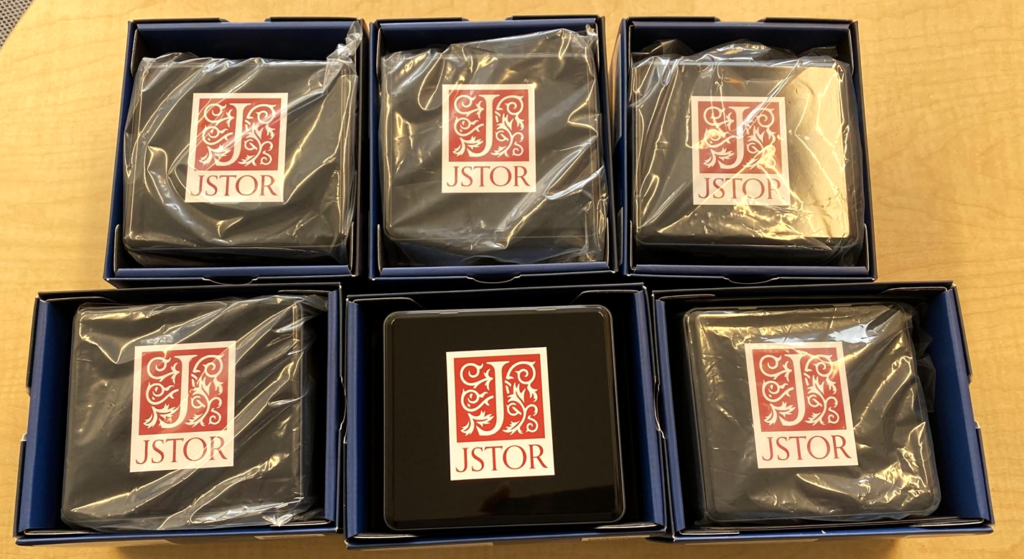
Our new solution offers a number of advancements that will help increase access for incarcerated researchers to scholarly material. Installed on a small server called a NUC that is not much bigger than a paperback book, our solution contains the JSTOR search index, the full-text content for all open access content, as well as workflow software both to configure the system and to manage students’ requests. When they access it, students conduct searches much as they would on the main JSTOR platform, except that when they find an article, rather than click through to read it, they request the article, where it gets moved into an administrative request queue. This allows administrators to review and fulfill the requests. When connected to the internet, the device will automatically update both functionality and content, dramatically improving our ability to maintain and improve these systems moving forward.

If you are a prison education program interested in our support for prison education, please let us know! We’ll keep you informed of our progress on the project and, when we have them, share our plans for scaling this solution to other programs.
Related content
October 3, 2022
Supporting the Academic Research Needs of Incarcerated Students: Building JSTOR’s Offline Solution for Prison Education
A JSTOR Labs white paper by Alex Humphreys, Laura Hillegas, Jessica Pokharel and Ronald Snyder.

By Alex Humphreys
October 14, 2022
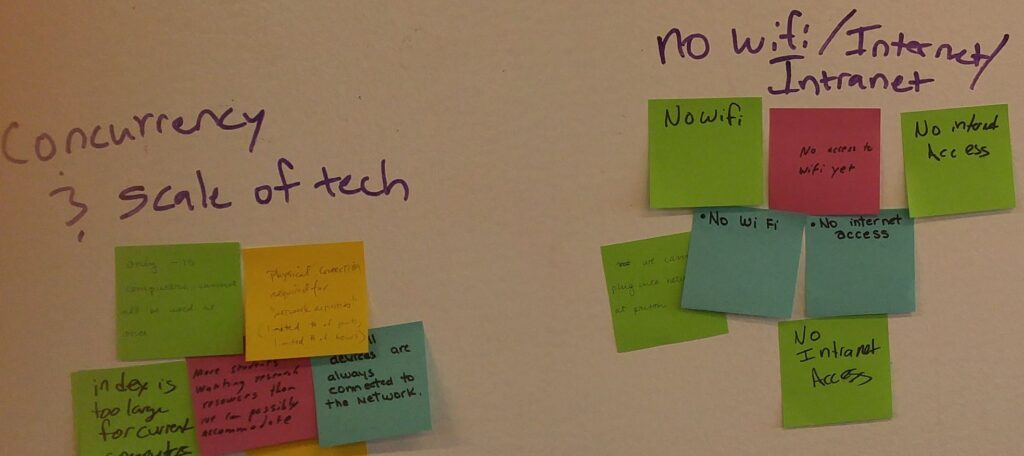
Constraint-storming, Not Brainstorming
Exploring the constraints governing the design of JSTOR's offline solution for prison education.
By Alex Humphreys

JSTOR Access in Prison Initiative
The JSTOR Access in Prison Initiative is a three year project to scale access to JSTOR to all higher education in prison (HEP) programs in the United States.